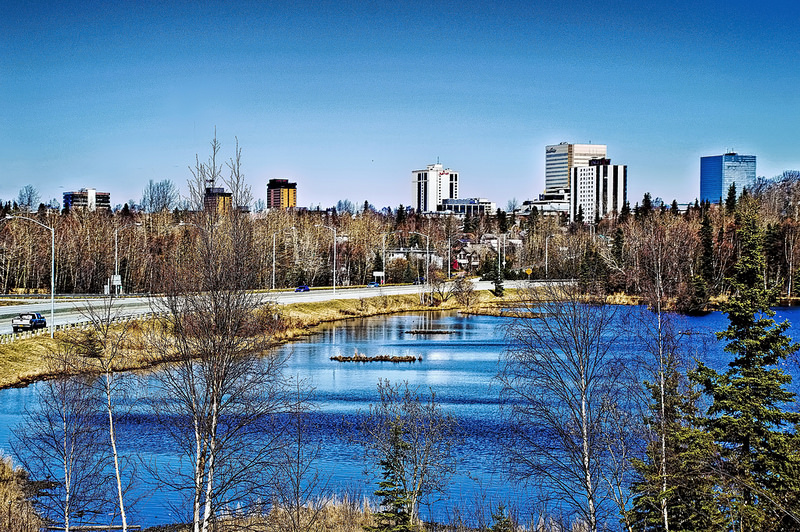
Anchorage
Historical Highlights
Anchorage is officially a municipality in the Borough of Anchorage in the south-central part of Alaska. The original inhabitants were the Athabascan Indians who called themselves Dena'ina, also known as Tanaina meaning "the people."
In 1741, Russians had reached the mainland of Alaska, followed by the British, Spanish and Americans. Captain James Cook with two ships, the Resolution and the Discovery, in 1778 sailed into Cook Inlet, which George Vancouver named after Cook in 1794. Another famous captain under Cook's command was William Bligh, famous for Mutiny on the Bounty; he was Sailing Master on Cook's third and final voyage. Bligh named Turnagain Arm, which is one of only about 60 bodies of water in the world to exhibit tidal bores. A tidal bore is a phenomenon in which the leading edge of the incoming tide forms a wave that travels up a river or narrow bay against the river's currents.
In June 1867, the United States purchased Alaska from Russia for $7,200,000. Secretary of State William Seward had argued with a reluctant Congress "If we would provide defense for the United States, we must have… Alaska to dominate the North Pacific."
The first oil claims in Alaska were filed in the 1890s, on the Iniskin Peninsula on the west shore of Cook Inlet. The Russians knew of oil seepage on land at Iniskin Bay and Cold Bay during their occupation of Alaska. They made no attempts to do anything about the finds. From the time the Russians knew of oil until the first major discovery at Swanson River in 1957 there were many signs of oil. Prudhoe Bay oil field on Alaska's North Slope in 1967 established Alaska as a world-class oil and gas province. Anchorage benefits greatly from the oil companies that have their headquarters in Anchorage.
In 1915, President Woodrow Wilson authorized funds for the construction of the Alaska Railroad. The headquarters was at the mouth of Ship Creek in Anchorage. A "tent city" at Ship Creek quickly saw the population grow to more than 2,000. Anchorage was named by the United States Post Office as an abbreviation of "Knik Anchorage." The area was a transfer site for passengers and supplies heading to Knik, serving as a trading and transportation center for gold and coal mining region from 1898 to 1919, when the railroad reached Anchorage. The Alaska Railroad was completed in 1923. President Warren G. Harding drove the ceremonial golden spike commemorating the completion.
In 1939, President Roosevelt allocated 50,000 acres between Anchorage and the Chugach Mountains for military bases. This became Elmendorf / Richardson Base. Later they became individual bases--the Air Corps at Elmendorf and the infantry and support at Richardson.
The federal government spent billions on military bases, air fields, ports, roads and highways, which became a big influence for post-war economic growth. The permanent military presence continued into the Cold War as Alaska became America's northernmost military defensive outpost. For Anchorage, the war played an important role in it becoming the largest and most dominant city in Alaska.
While standing in the middle of Anchorage, you can see the Chugach, Kenai, Talkeetna, Tordrillo, Aleutian, and Alaska mountain ranges. On a clear day, 130 miles north, Mount McKinley can be seen. At 20,237 feet, it is the tallest mountain in North America.